What does this mean for the region and the world?
- Written by: Michael Toole, Associate Principal Research Fellow, Burnet Institute
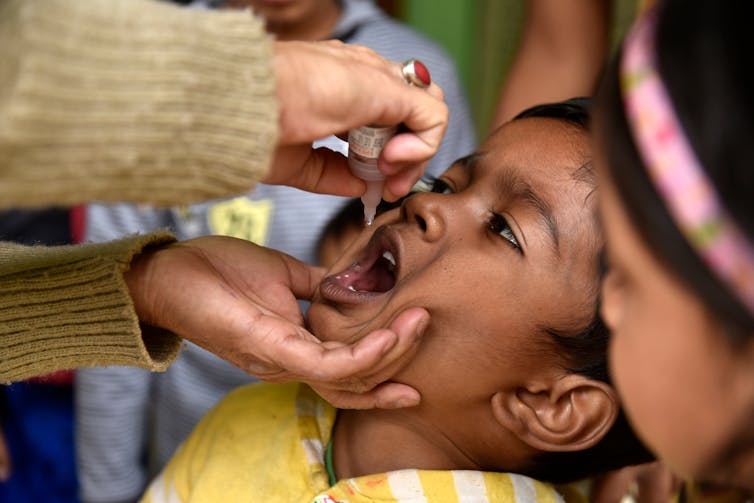
As war continues to devastate Gaza and its people, we learnt last week that a variant of poliovirus[1] has been detected in the region. The virus was isolated in six sewage samples collected in late June from Khan Younis and Deir al Balah.
Most infections with poliovirus don’t cause symptoms, but a minority of those who contract the virus develop paralysis[2] (paralytic polio).
No cases of paralytic polio have been reported in Gaza. But detecting the virus in wastewater is concerning nonetheless.
There are different types of polio
The cases of polio we’ve seen historically have generally been caused by “wild poliovirus”. For centuries, wild poliovirus affected both poor and wealthy countries, including Australia. The deployment of effective vaccines[3] in the 1960s led to a dramatic decrease in cases in the following decades among those countries that could afford the vaccines.
The introduction of the Global Polio Eradication Initiative[4] in 1988 enabled more equitable vaccination. There were only 12 cases of paralysis[5] caused by wild poliovirus in 2023, in just two countries: Pakistan and Afghanistan.
However, as the number of wild poliovirus cases decreased there was an increase in cases of vaccine-derived poliovirus causing paralysis.
There are two types of polio vaccines: one is given orally, and the other by injection (the type used in Australia). The oral polio vaccine is based on a weakened virus – so it doesn’t cause disease, but can still reproduce. Vaccine-derived poliovirus emerges when people vaccinated with the oral polio vaccine[6] excrete the vaccine virus in their stool and it spreads to other people.
Over time, it may mutate to become a virus that circulates and causes paralysis in populations with low levels of immunity. In 2023, there were 524 polio cases[7] in 32 countries caused by vaccine-derived poliovirus.
It’s a strain of vaccine-derived poliovirus that has been detected in the wastewater in Gaza – type 2[8].
High vaccination coverage is key, but not always enough
The most important indicator of eradicating polio, both wild and vaccine-derived, is vaccine coverage. This is usually measured as the percentage of children under five who have received at least four vaccine doses, ideally 95%.
High vaccination coverage has been achieved by a combination of routine immunisation in early childhood plus national or local catch-up vaccination campaigns, particularly in areas where the virus pops up[9].
However, high vaccination coverage is not always enough to eliminate the virus.
Early in the 21st century, India and Nigeria[10] were reporting the highest number of polio cases in the world. After an accelerated immunisation campaign in India, vaccine coverage rates were high by 2007 and cases were decreasing. But many cases continued to be reported in impoverished districts of western Uttar Pradesh (a state in northern India), where access to clean water and sanitation was poor.
Research shows a high level of pathogens in children’s intestines can make the absorption of the oral vaccine[11] less effective, while unsanitary conditions make it easier for the virus to spread. After a sanitation and hygiene project began in 2007[12], the last case of polio in Uttar Pradesh occurred in 2010[13], and the entire country eradicated polio in 2014[14].
Wild polio was eradicated[16] from Gaza more than 25 years ago. But it’s possible the re-emergence of vaccine-derived poliovirus is due to a combination of poor hygiene and sanitation[17], as we saw in Uttar Pradesh, and reduced vaccine coverage.
Polio vaccination coverage in the Palestinian territories was 99% in 2022[18]. By the end of 2023, coverage had dropped to 89%. However, the data were not separated by each of the territories (the West Bank, East Jerusalem and Gaza), so coverage may be lower in Gaza.
Recent outbreaks
We saw the detection of a similar strain[19] of poliovirus in wastewater in Jerusalem, London and New York in early 2022.
Parts of these cities have high concentrations of ultra-Orthodox Jews, which may have lower rates[20] of vaccination than the overall population. In Rockland County[21], 65 kilometres north of New York City, a young, unimmunised Orthodox Jewish man became the first case of polio transmitted locally in the United States in 30 years[22].
There’s no evidence of vaccination hesitancy among Ultra-Orthodox Jews in Australia. However, there are other communities where vaccination rates are low, including some shires in the Northern Rivers district[23] of New South Wales.
Communities with low vaccination rates, whatever the reason, are vulnerable to infectious diseases such as polio.
So where did this virus come from?
The oral vaccine used in Gaza has not contained type 2 since 2016[24], so it must have come from elsewhere.
In 2023, most outbreaks of type 2 vaccine-derived poliovirus[25] were in the Democratic Republic of Congo, Yemen, Nigeria, Sudan and Somalia. There was also one case in Egypt, which borders on Gaza. Egypt could be the source of this virus, but we’ll need further investigation.
It’s unlikely to have come from Israel as there have been no detections of poliovirus in wastewater there since 2022[26].
What can the world learn?
First, we must not forget that poliovirus can cross borders and maintaining high vaccination rates in Australia and elsewhere is the most effective protective strategy. It’s also crucial to contain the virus inside Gaza. UNICEF and partners are preparing for a vaccination campaign[27] focusing on young children.
Second, it’s important to maintain wastewater surveillance for polio, which is an early warning mechanism that can initiate public health action before symptomatic cases occur.
In 2022, Victoria was the only Australian state conducting routine polio wastewater surveillance until NSW[28] adopted the practice when the outbreaks in Jerusalem, New York and London occurred. Wastewater surveillance is worthwhile in all states and territories.
Third, but not least, this should be a wake-up call highlighting the need to cease hostilities and provide unrestricted access by aid agencies to improve the provision of clean water, sanitation and effective health services throughout Gaza. This is an urgent global health priority.
References
- ^ poliovirus (polioeradication.org)
- ^ develop paralysis (theconversation.com)
- ^ effective vaccines (www.who.int)
- ^ Global Polio Eradication Initiative (www.cdc.gov)
- ^ 12 cases of paralysis (polioeradication.org)
- ^ oral polio vaccine (theconversation.com)
- ^ 524 polio cases (www.cdc.gov)
- ^ type 2 (polioeradication.org)
- ^ the virus pops up (theconversation.com)
- ^ India and Nigeria (polioeradication.org)
- ^ absorption of the oral vaccine (pubmed.ncbi.nlm.nih.gov)
- ^ began in 2007 (www.iapsmupuk.org)
- ^ in 2010 (iple.unicef.in)
- ^ in 2014 (www.bbc.com)
- ^ Talukdar David/Shutterstock (www.shutterstock.com)
- ^ was eradicated (news.un.org)
- ^ hygiene and sanitation (edition.cnn.com)
- ^ 99% in 2022 (polioeradication.org)
- ^ a similar strain (www.reuters.com)
- ^ lower rates (www.sciencedirect.com)
- ^ Rockland County (www.cdc.gov)
- ^ in 30 years (www.bmj.com)
- ^ Northern Rivers district (www.echo.net.au)
- ^ since 2016 (www.nejm.org)
- ^ type 2 vaccine-derived poliovirus (applications.emro.who.int)
- ^ 2022 (www.mdpi.com)
- ^ a vaccination campaign (gna.org.gh)
- ^ NSW (www.thenewdaily.com.au)
Read more https://theconversation.com/polio-in-gaza-what-does-this-mean-for-the-region-and-the-world-235178