

Relief on energy bills for all in a federal budget that bets on lower inflation
- Written by: Michelle Grattan, Professorial Fellow, University of Canberra
A $300 energy rebate for all households from July 1 and a 10% increase in Commonwealth Rent Assistance are key measures in a budget targeting cost-of-living relief that put downward pressure on inflation.
Delivered by Treasurer Jim Chalmers on Tuesday night, the budget also freezes the maximum cost of Pharmaceutical Benefits Scheme (PBS) prescriptions for everyone for the year of 2025 and concession card holders for five years.
As Chalmers told federal parliament, “this is a budget for the here and now and it’s a budget for the decade to come”.
After an estimated surplus of $9.3 billion this financial year, a deficit of $28.3 billion is forecast for next financial year, before rising to $42.8 billion in 2025-26. The projected deficits then reduce to smaller but still substantial amounts in the following two years. Across the budget period, deficits total $112.8 billion.
The various cost-of-living measures are expected to take 0.5 of a percentage point off inflation over the coming year, as the government tries to boost the prospect of an interest rate fall before the election.
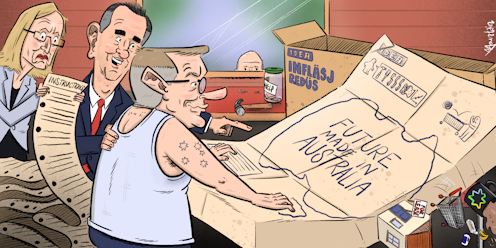
Looking to boost growth in the longer term, the budget invests $22.7 billion in a Future Made in Australia package over a decade to “help make us an indispensable part of the global economy”. This funding is loaded into the latter stages of the decade.
This includes $13.7 billion for production tax incentives for green hydrogen and processed critical minerals “so industries are rewarded for scale and success”.
A $1.7 billion Future Made in Australia Innovation Fund aims to “develop new industries like green metals and low carbon fuels” and $520 million is allocated “to deepen net zero trade and engagement with our region”.
The policy will have a National Interest Framework to impose “rigour” on government decisions.
The energy relief, which will be provided through the states and providers, costs $3.5 billion over three years and will also extend to one million small businesses, which will get $325.
Households will benefit from the energy help at the same time as all taxpayers receive a tax cut, which is worth an average of $36 a week.
The boost in Commonwealth Rent Assistance – coming after a 15% rise in last year’s budget – will cost $1.9 billion over five years. New investment in housing is $6.2 billion.
Chalmers said the budget showed the government was “realistic about the pressures people face now – and optimistic about the future”.
Treasurer Jim Chalmers told his news conference that on inflation it was “not mission accomplished because people are still hurting.”
International uncertainty combined with cost-of-living pressures and high interest rates will slow the economy, with growth forecast at 1.75% this financial year and 2% in the next.
Unemployment is set to rise to 4.5% by the June quarter next year. Unemployment is currently at 3.8%
“I want Australians to know that despite everything coming at us, we are among the best placed economies to manage these uncertainties and maximise our opportunities,” Chalmers said.
He said the government was limiting real spending to an average of 1.4% a year since it came to office. It will be an estimated 3.6% in the coming financial year.
The budget contains earlier announced changes to the indexation arrangements for HELP student debt and placement payments for teaching, social work and nursing students.
Read more: At a glance: the 2024 federal budget split four ways[1]
There is $2.2 billion to deliver more key reforms in aged care. The budget also includes unspecified provisions for wage rises in aged care and child care.
Shadow treasurer Angus Taylor said: “In this budget, Labor has added $315 billion of new spending, at a time when we need restraint.
"After two years in office and three Labor budgets, the government is no closer to dealing with its homegrown inflation crisis – which means more pressure on cost of living and interest rates higher for longer.”
Greens leader Adam Bandt said: “This band-aid budget is a betrayal of renters, women, students and mortgage holders. Labor’s offering a future for coal and gas that will wreck the climate, unleash corporate greed, and throw ordinary people to the wolves”.
Read more: Chalmers is bitten by the giveaway bug in a budget that contains good news for almost everyone[2]
References
- ^ At a glance: the 2024 federal budget split four ways (theconversation.com)
- ^ Chalmers is bitten by the giveaway bug in a budget that contains good news for almost everyone (theconversation.com)










