why the Gen X classic still stands up today
- Written by: Adam Daniel, Associate Lecturer in Communications, Western Sydney University
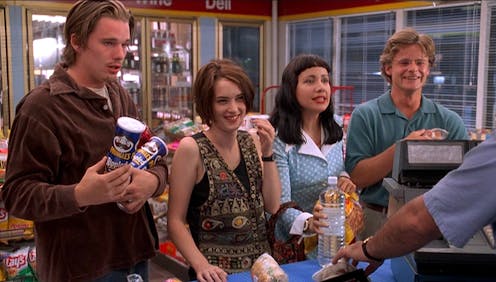
“I was really going to be something by the age of 23,” says Lelaina Pierce, played by the radiant Winona Ryder in the 1994 Gen X classic Reality Bites.
She was voicing an anxiety many would say was born in the post-boomer demographic of the film’s disenfranchised central characters – but it is still a familiar anxiety today, 30 years on from the film’s release.
Reality Bites was the first feature for director Ben Stiller, then known mostly for his TV comedy work, and the first script penned by then 20-something writer Helen Childress, drawing from her own life experience.
Lelaina is a dissatisfied university graduate confronting the realities of life after graduation while making a documentary about her equally disaffected friend group.
Despite graduating at the top of her class, Lelaina is stuck in a producer’s assistant role on a Houston morning show – until she is unceremoniously fired. Complicating matters, she is also trapped in a love triangle with corporate Michael (played by Stiller) and slacker Troy (Ethan Hawke), two men who represent a key philosophical fork in the road for many Gen Xers: to “sell out” or not.
Reality Bites continues to resonate with new generations of viewers. It is a timeless story of young adults navigating love, friendship and career uncertainties.
A film for Gen X
At the time of release, The New York Times’ Frank Rich declared[1]:
This is the movie that has been both praised as the last word on X-ers and damned as Hollywood’s slickest effort yet to exploit them.
There are however genuine joys, despite the slickness critique. Among them, the acerbic humour of Janeane Garofolo and Steve Zahn, in memorable roles; the killer 90s soundtrack, featuring Lisa Loeb, Crowded House and World Party; and two career-defining roles for Ryder and Hawke, who may be more familiar to younger audiences for Stranger Things and The Black Phone. Hawke’s brooding intellectual and Ryder’s luminous yet sardonic girl-next-door established personas for the duo that persisted throughout the decade.
Read more: Nostalgia, VHS and Stranger Things' homage to 80s horror[2]
The themes of the film are surprisingly relevant given the generational differences between audiences of the early 90s and today. Although the film examines the complicated issues of the AIDS crisis and homophobia of the era, it also adeptly examines the universal anxieties of identity crisis, disillusionment and the search for authenticity.
Despite clear generational differences in fashion, lifestyle and music, the response to the film by new audiences tends to be one of resonance and recognition[3].
A timeless premise for a romantic drama, the love triangle at the centre of Reality Bites remains compelling. Following Lelaina’s meet-cute car accident with TV executive Michael, the couple start dating. But Lelaina can’t overcome her attraction to Troy, who positions himself as the anti-Michael; he’s more interested in his amateur band and just hanging out than he is in starting a career.
When he and Lelaina finally come together in the aftermath of a fight with Michael over commercialising her documentary, it’s presented as soulful and deeply romantic. However, Troy is unable to handle the intimacy of their burgeoning relationship and walks out on her the following morning. Spoiler Alert: Lelaina forgives him for leaving, and their embrace and kiss is one of the final images of the film.
A worthy rewatch
What has struck me upon multiple rewatches over the last 30 years is how much my personal reaction to Lelaina’s eventual decision to dump Michael in favour of Troy has shifted. Troy is shown throughout the film to be callous, self-centred and in need of therapy, while Michael is generous and kind, if a little dorky
When I first watched the film as a teenager it was easy to get hoodwinked into aligning with Lelaina’s choice of Troy. Watching the film as an adult who is closer in age to Lelaina’s parents, the choice is less clear. Were Michael’s actions so egregious?
In hindsight, the Gen X obsession with selling out no doubt played a significant role in how Michael and Troy were perceived at the time of release. Michael’s attempt to turn Lelaina’s creative work into money was seen as inauthentic, while Troy’s lack of aspirations for his music career were perceived as rebellious and genuine.
A contemporary generation of media creators are seemingly less critical of attempts to monetise their artistry. The act of personal “branding[4]” and building an audience are common to platforms such as TikTok and YouTube, in a manner that Troy and Lelaina would likely find shameful.
But I’m certainly not the first to make the case that Lelaina made an error[5].
At the Tribeca Film Festival’s 25-year anniversary screening, Ryder herself admitted she thought Lelaina would end up in a lesbian relationship with Garofalo’s Vickie after Troy’s novelty faded.
Whichever side you end up taking, the film’s rocking soundtrack, charming performances and snarky humour make it a worthy rewatch.
Read more: Baby boomers, Gen X, Millennials and Gen Z labels: Necessary or nonsense?[6]
References
- ^ declared (www.nytimes.com)
- ^ Nostalgia, VHS and Stranger Things' homage to 80s horror (theconversation.com)
- ^ resonance and recognition (www.themarysue.com)
- ^ branding (www.vox.com)
- ^ Lelaina made an error (www.instyle.com)
- ^ Baby boomers, Gen X, Millennials and Gen Z labels: Necessary or nonsense? (theconversation.com)
Read more https://theconversation.com/reality-bites-at-30-why-the-gen-x-classic-still-stands-up-today-223185