Opera Australia finds the joy in The Magic Flute, Mozart’s most-performed opera
- Written by: David Larkin, Senior Lecturer in Musicology, University of Sydney
The sheer familiarity of The Magic Flute, Mozart’s most-performed opera, can blind one to its inherent oddness. It draws on a range of influences, from ancient Egyptian symbolism and freemasonry to European politics (the character of the Queen of the Night has been read as[1] a covert allusion to former Austrian Empress Maria Theresa).
Librettist Emanuel Schikaneder has created something that is part allegory, part dream and part fairy tale. That this mish-mash elicited some of Mozart’s greatest and most popular music should shake up ingrained notions of classical music as something po-faced and humourless.
Embracing silliness
Unlike the three Italian opere buffe[2] that Mozart composed to the libretti of Lorenzo da Ponte, The Magic Flute avoids recitative[3] – sung speech – in favour of spoken German dialogue. In the recording I first got to know, Klemperer’s legendary version[4] from 1964, only the sung portions were included. This tilted the work’s balance away from the silly and towards the sublime.
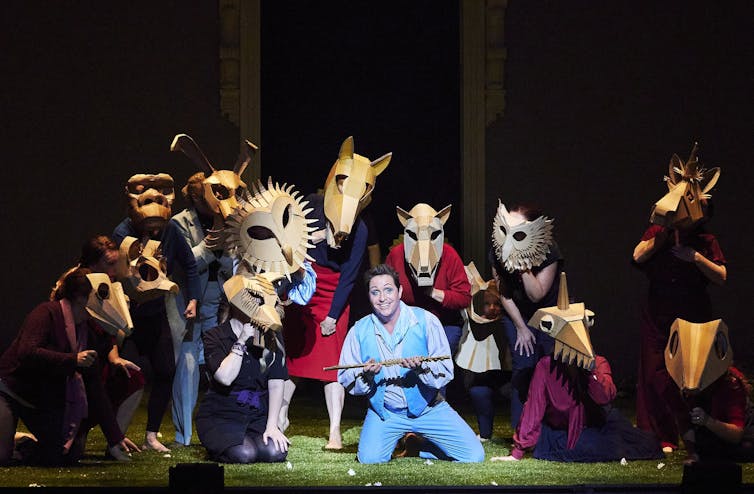
A new production by Kate Gaul for Opera Australia does not shy away from pantomime silliness from the start. The monster threatening Tamino (Michael Smallwood) is rendered as a silhouette projected by a child with a torch, and Papageno (Ben Mingay) is first seen in the stalls engaging with audience members before making his way to the stage.
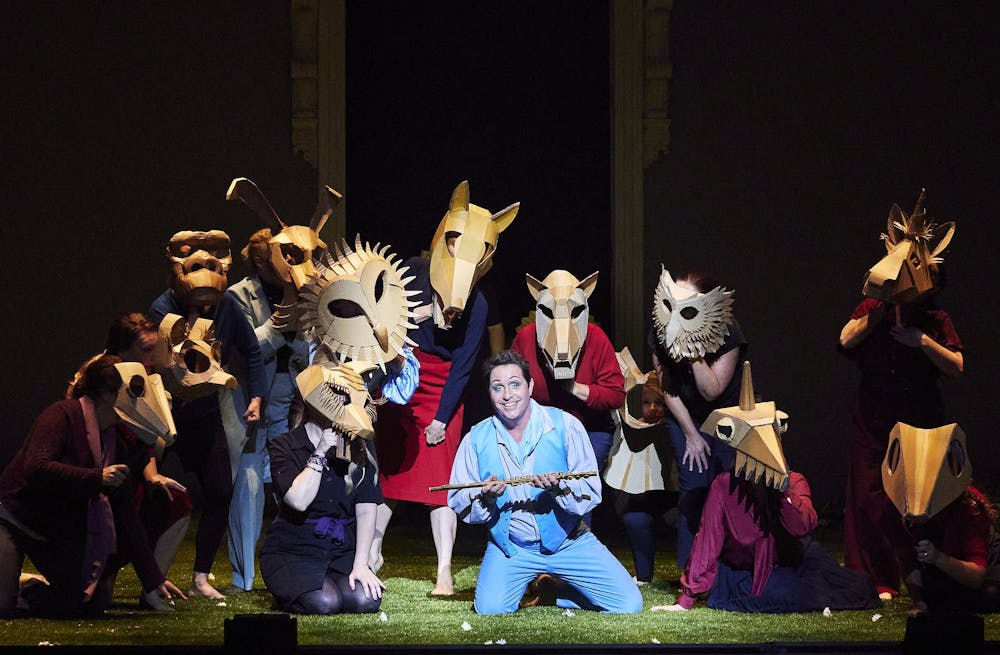
Key to bringing out the humour is presenting the opera in English. The translation by Gaul and Michael Gow has some chortle-worthy lines. “Am I hard of hearing, or is no one volunteering?” sings Papageno as he vainly seeks a woman – any woman – to satisfy his romantic urges. This character is given a decidedly ocker makeover, complete with an esky and allusions to beers and barbies.
Thankfully, more serious moments for other characters – including Sarastro’s arias (sung with gravitas by David Parkin) and Pamina’s lament (heart-rendingly performed by Stacey Alleaume) – are allowed to unfold without forcing the comedy.
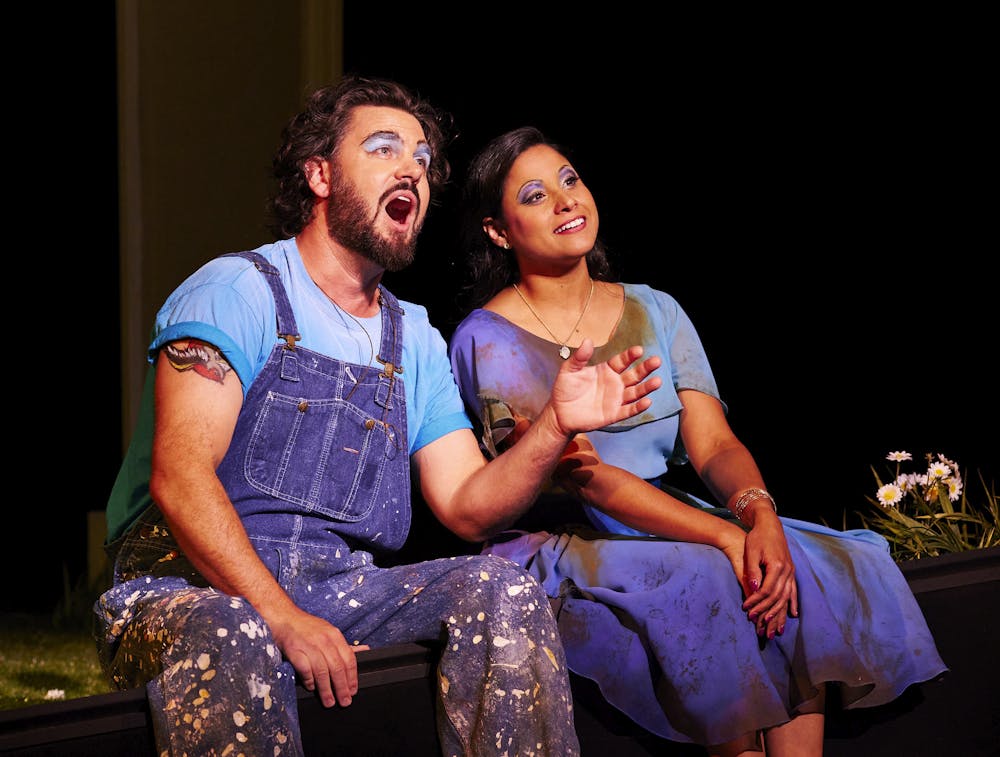 Ben Mingay and Stacey Alleaume are cast as Papageno and Pamina.
Keith Saunders/Opera Australia
Ben Mingay and Stacey Alleaume are cast as Papageno and Pamina.
Keith Saunders/Opera Australia
Read more: Barrie Kosky's The Magic Flute is a contemporary spectacle, despite the opera's outdated attitudes[5]
Campy costumes and an ornamental set
Opera Australia’s previous Magic Flute by Julie Taymor reduced the overture to its opening three chords. It is a relief to hear it in full in this production, directed with sureness of touch by Teresa Riveiro Böhm. The orchestra provides a fulsome sound and crisp articulation over the evening, with just a handful of uncoordinated moments between the pit and stage.
Special commendations are due to the flautist and glockenspiel player for their fine solos (the latter was a role taken on by Mozart for the first performance). Weirdly, Tamino held his on-stage flute up in the air instead of miming, creating an odd disconnect between sight and sound. By contrast, the enforced response of Monostatos (Kanen Breen) and his henchmen to the sound of the magic bells was a hilarious spasm of dancing, macarena moves included.
The costumes by Anna Cordingley are eclectic. Cordingley uses guano-stained tradie attire for the bird-catcher Papageno, simple blueish outfits for Tamino and Pamina, red overalls and outsized glasses for Monastatos, and a gaudy gold cloak for Sarastro. All the villains are changed into tie-dye hippy clothes for the final chorus.
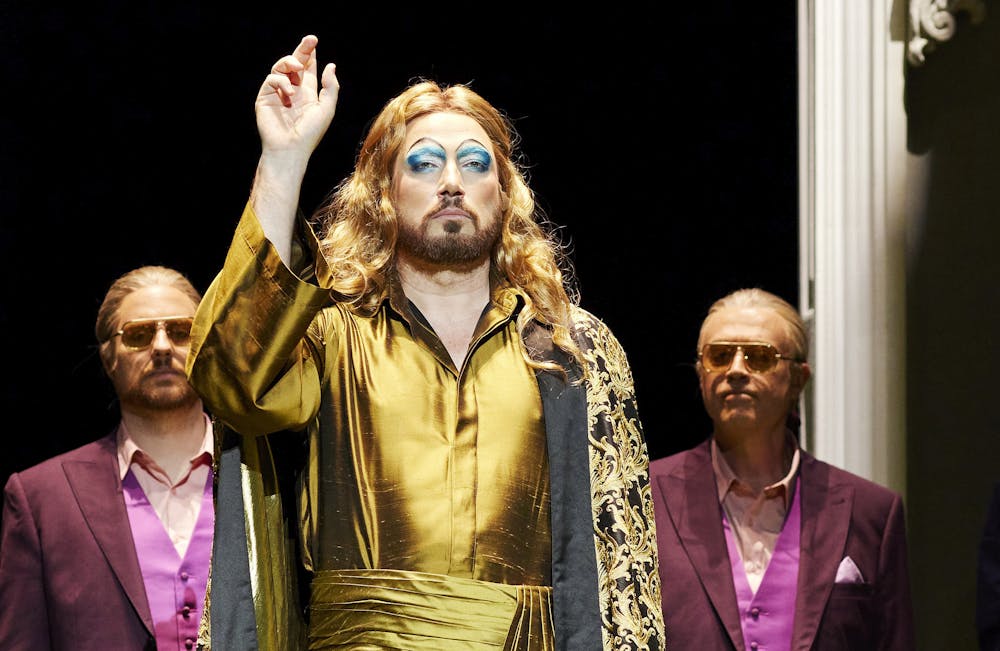 David Parkin portrays Sarastro in a gaudy gold cloak and bold eye makeup.
Keith Saunders/Opera Australia
David Parkin portrays Sarastro in a gaudy gold cloak and bold eye makeup.
Keith Saunders/Opera Australia
The Queen of the Night (Giuseppina Grech) asserts her pantomime villain credentials with her platinum blonde hair, vampish fur and feather costume. Outdoing even this for connoisseurs of camp is the late appearance of Papagena (Jennifer Black) in a Brazilian-carnival-style bird costume.
Michael Yeargan’s set has a three-sided exterior surrounding grass, with ornamental entrances on each side. Shiny ribbon curtains represent the fire and water tests, with other curtains repeatedly drawn across the middle of the stage for projections and byplay between characters.
Read more: The tale of two queens: flipping the script on the ‘princess culture' in opera[6]
Spell-casting performances
Needless to say, the Queen of the Night’s two arias are among the most applauded. Grech conquers the stratospheric coloratura with aplomb. But for me, the standout voice belongs to Alleaume, who brings a burnished legato to Pamina’s arias, but also playfulness in the ensembles.
 Actor Stacey Alleaume shines as Pamina.
Keith Saunders/Opera Australia
Actor Stacey Alleaume shines as Pamina.
Keith Saunders/Opera Australia
Ben Mingay is a seasoned musical theatre performer and aside from some roughness in tone quality, he takes on the role of Papageno with assurance and brings out the humour and humanity of the character.
Smallwood has a pleasing light lyrical tenor as Tamino – less forceful than some exponents of the role, but tuneful and exemplary in his diction.
The three spirits, extended and demanding roles for child singers, are sensibly double cast, and the opening night trio of Abbey Hammond, Zev Mann and James Valanidas demonstrate sureness of ensemble and decent acting chops. The adult trio of Ladies, Jane Ede, Indyana Schneider and Ruth Strutt, work very well together.
 The production features Indyana Schneider as Second Lady, Jane Ede as First Lady and Ruth Strutt as Third Lady.
Keith Saunders/Opera Australia
The production features Indyana Schneider as Second Lady, Jane Ede as First Lady and Ruth Strutt as Third Lady.
Keith Saunders/Opera Australia
Of his big numbers, Parkin as Sarastro (and Speaker) is probably most satisfactory in the aria, Within these sacred halls, which sits higher in his register. His brave but unwise decision to go for the final unwritten low “E” reveals his problematic bottom register, which is often distorted with vocal fry.
Breen brings his trademark comic gifts to Monostatos who, like the other villains, is welcomed into the fold at the end. Gregory Brown and Nathan Lay are solid priests.
Whether one enjoys a laugh, or finely sung sentimental numbers, this production has something for everyone. It may not have solved all the conundrums of the work, but at least one gets to appreciate Mozart’s genius uncut.
Opera Australia’s The Magic Flute[7] is at the Sydney Opera House until March 16.
References
- ^ been read as (www.eno.org)
- ^ opere buffe (en.wikipedia.org)
- ^ recitative (en.wikipedia.org)
- ^ Klemperer’s legendary version (www.classicstoday.com)
- ^ Barrie Kosky's The Magic Flute is a contemporary spectacle, despite the opera's outdated attitudes (theconversation.com)
- ^ The tale of two queens: flipping the script on the ‘princess culture' in opera (theconversation.com)
- ^ The Magic Flute (opera.org.au)