Barilaro report fails to put NSW government integrity crisis to rest
- Written by: Andy Marks, Pro Vice-Chancellor, Strategy, Government and Alliances, Western Sydney University
It took George Orwell just one line to describe a political dystopia[1]: “It was a bright cold day in April, and the clocks were striking thirteen.”
In contemporary NSW politics, it seems, it takes two inquiries, multiple press conferences, rolling media coverage, and a ministerial resignation.
At 57 pages, the Ernst & Young report[2] into a senior NSW government trade appointment to the Americas takes only five pages to get to the heart of the matter. Then it takes a different direction.
“Public servants and the public alike”, states the report’s author, former public servant, Graeme Head, “should be able to have confidence that Public Service appointments are being made in the way they are intended to be.” He is right. Confidence is the central consideration.
Read more: How 'fast' politics has left the NSW government staring into the electoral abyss[3]
The trouble is, NSW Premier Dominic Perrottet looks to have afforded Head little latitude to directly scrutinise the issue the author calls out; specifically, the matter of public confidence. The public’s voice is relatively silent through the remainder of the report. This is essentially because the document’s scope is largely confined to examining the rules of the game instead of the real question: the spirit in which it is played.
This is not to suggest the process and legality of senior public service appointments should not be closely scrutinised. The EY report does that. The outcome then is as expected. Put simply, in the same way a plumber lays pipes, governments should follow process. That it is necessary for a report to spell that fact out to a 12-year-old administration is telling.
Head recommends the relevant act be amended to ensure senior public servants are “not subject to the direction of a Minister in respect of any of their employer functions”.
The ministerial code of conduct, he adds, should also be modified to prevent “a minister from seeking to influence” a public servant “in respect of their employer functions”. Resorting to law and codified minutia to protect fundamental public service principles is hardly cause for public confidence. It is a sign something is very wrong.
The provisions the report recommends, while entirely logical as regulatory responses, do not address the root of the apparent transgressions: culture. Political culture in NSW has reached a juncture where transgressions that seem obvious to all are invisible to those with the clearest vantage point.
Asked about concerns over the appointment in June, the premier responded[4]:
I’m still unaware of what the substantive issue here is.
Even without foreseeing questions over process, or a willingness to acknowledge the political optics, the premier’s inability to gauge possible public apprehension over of the appointment is interesting.
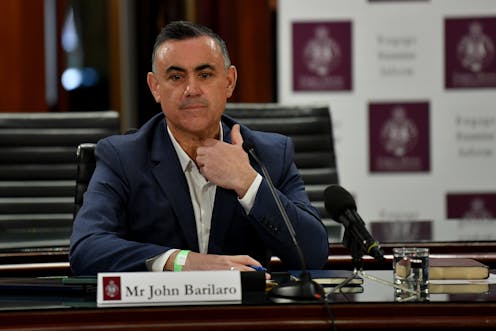
Quizzed on the same matter, former deputy premier and the successful candidate for the since relinquished position, John Barilaro, maintained[5] he followed the process. Similarly, former minister and deputy NSW Liberal leader, Stuart Ayres, also insisted[6] he had “done nothing wrong”.
Others close to the process appear more capable of grasping the challenges at hand. Asked how the candidate’s appointment was confirmed before the selection committee’s report was signed, Investment NSW head and departmental secretary, Amy Brown remarked[7] the “high degree of disorganisation” surrounding the process was “not ideal[8]”.
The candidate who was reportedly initially offered the trade role, Jenny West, stated the offer was then rescinded as it would instead be “a present for someone[9]”. West added she was told she was “an extraordinary performer[10]” on having the offer withdrawn.
Read more: NSW government slides further into trouble as Perrottet struggles for clear air[11]
Commenting on the planned political management of anticipated criticism of the eventual trade role appointment, public service commissioner Kathrina Lo remarked[12], “I should not be viewed as cover for a recruitment process”.
The most salient observation came from Premier and Cabinet head Michael Coutts-Trotter, who reportedly texted that the establishment of an inquiry into the appointment was “utterly predictable[13]”. Indeed.
Predictably, the release of the EY report will not put an end to questions of integrity, culture and accountability. Because the right questions are not being asked.
Meanwhile, the implications of recently released Broderick report[14] into bullying, harassment and sexual misconduct within NSW Parliament are just emerging. And at the federal level, the transparency of ministerial appointments[15] is under scrutiny over revelations of former Prime Minister Scott Morrison’s multiple portfolio assignations.
The clock is striking thirteen.
References
- ^ political dystopia (www.orwellfoundation.com)
- ^ Ernst & Young report (www.dpc.nsw.gov.au)
- ^ How 'fast' politics has left the NSW government staring into the electoral abyss (theconversation.com)
- ^ responded (amp.smh.com.au)
- ^ maintained (amp.theguardian.com)
- ^ insisted (www.abc.net.au)
- ^ remarked (www.smh.com.au)
- ^ not ideal (www.smh.com.au)
- ^ a present for someone (amp.abc.net.au)
- ^ an extraordinary performer (amp.abc.net.au)
- ^ NSW government slides further into trouble as Perrottet struggles for clear air (theconversation.com)
- ^ remarked (www.afr.com)
- ^ utterly predictable (amp.smh.com.au)
- ^ Broderick report (www.parliament.nsw.gov.au)
- ^ transparency of ministerial appointments (www.theguardian.com)