The UK just hit 40℃ for the first time. It's a stark reminder of the deadly heat awaiting Australia
- Written by: Andrew King, Senior Lecturer in Climate Science, The University of Melbourne
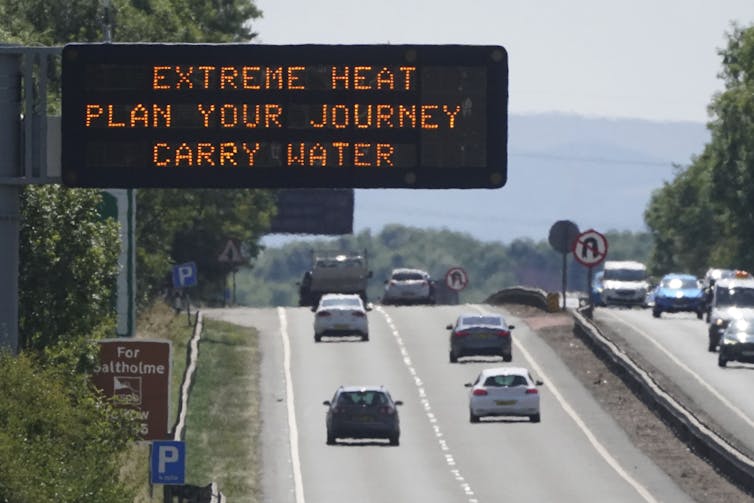
A severe heatwave in Western Europe is shattering temperature records – including in the United Kingdom, where temperatures exceeded 40℃[1] on Tuesday for the first time on record.
The village of Coningsby in eastern England reached 40.3℃[2] – provisionally the hottest temperature in UK history. The record was previously held by Cambridge, which reached 38.7℃ in 2019.
I’m a scientist interested in climate change and extreme weather. I grew up in the UK and remember major heatwaves in 2003 and 2006 during my school holidays.
Traditionally, temperatures above 30℃ in the UK are considered hot. But to see temperatures already exceeding 40℃ is shocking.
Summer heat may be far from people’s minds here in Australia. But Europe’s ordeal is yet another sign that changes in Earth’s climate have already reached dangerous levels. If the UK can reach 40℃, Australia must brace for even deadlier temperatures.
A nation ill-prepared
Europe’s heatwave spread across Spain, Portugal and southern and western France, before a strong southerly wind fanned continental air across the English Channel. Background warming due to climate change boosts the odds of such severe heat.
In 2020, a UK Met Office study[3] found under the current climate, there was likely a less than 1% chance of seeing 40℃ anywhere in the UK in a given year. Without human-caused climate change it would be virtually impossible.
The UK is simply not used to heat on this scale. In fact, buildings there are generally designed to retain heat rather than cool down. A report[4] last year found fewer than 5% of homes were air-conditioned.
Urban green space in the UK – which can help cool cities – has also declined[5] in recent years.
The Met Office on Friday issued the first ever “red warning” heat alert[6], which said “illness and death may occur among the fit and healthy, and not just in high-risk groups”. It advised people to:
Close curtains on rooms that face the sun to keep indoor spaces cooler and remember it may be cooler outdoors than indoors. Drink plenty of fluids and avoid excess alcohol, dress appropriately for the weather and slow down when it is hot. Be on the lookout for signs of heat related illness. Cool your skin with water, slow down and drink water.
The death toll from the current heatwave is not yet known, but experts say[7] it could be in the thousands across Europe.
But not all Britons see the extreme heat as a potentially lethal event. One Conservative MP went so far as to accuse[8] those taking precautions against the heat of being “cowards” and “snowflakes”.
And media reports have routinely featured images of people sunbathing on beaches and eating ice cream in parks. Research shows this may create a false impression[9] that spending time in the sun during heatwaves is safe.
Read more: Britain isn't built to withstand 40°C – here is where infrastructure is most likely to fail[10]
Lessons for Australia
Australia has, of course, experienced many days with temperatures of 40℃ or more. But we struggle when it persists for several days.
Research shows[11] the impacts of climate change are accelerating rapidly across ecosystems, food production, cities and towns, and health and well-being.
Heatwaves kill more[12] Australians than any other extreme weather event. Hospitals[13] are strained as admissions rise. Public transport can be disrupted[14], energy supplies come under pressure[15], and the bushfire risk increases.
Experts say extreme heat also poses[16] a substantial threat to Australia’s economy.
In January this year, temperatures in the Western Australian town of Onslow peaked at 50.7℃ – equalling the Australian record.
Globally, the number of days over 50℃ has doubled since the 1980s[17]. Such temperatures are still rare[18] in Australia. But as climate change worsens, more extremely hot days will occur across the continent.
Australia has warmed by around 1.4℃ since 1910[19], well ahead of the global average of 1.1℃[20]. Even if warming is kept below 2℃, Sydney and Melbourne are expected[21] to see 50℃ days in coming years.
In the summer of 2019-20 the Western Sydney suburb of Penrith came close, reaching 48.9℃[22].
Read more: This WA town just topped 50℃ – a dangerous temperature many Australians will have to get used to[23]
No time to waste
Greenhouse gas emissions have warmed the world, including Western Europe. This raises the likelihood of more extreme high temperatures, including records broken by wide margins[24].
The UK heatwave is just the latest reminder of what’s in store for Australia and the world as the climate changes. Last year, a severe heatwave[25] in western North America led to temperatures approaching 50℃ in Canada and broke records in parts of the Pacific Northwest.
Clearly, nations everywhere must consider measures to better handle future heatwaves. This is especially important in Australia, the driest inhabited continent on Earth. Here, drought and severe fire conditions can exacerbate the harms caused by extreme heat.
The UK government is under fire for ignoring previous expert calls[26] to create a national heat risk strategy. Australia must also do a better job on heatwave planning.
Finally, rapid emissions reduction is needed to limit further global warming. Until we reach net-zero greenhouse gas emissions globally, the planet will continue to warm. We have the time and tools[27] to avert an even worse planetary catastrophe, but we must act now.
Read more: Australia ranks last out of 54 nations on its strategy to cope with climate change. The Glasgow summit is a chance to protect us all[28]
References
- ^ exceeded 40℃ (www.theguardian.com)
- ^ reached 40.3℃ (www.independent.co.uk)
- ^ study (www.nature.com)
- ^ report (www.nytimes.com)
- ^ declined (www.theccc.org.uk)
- ^ heat alert (www.metoffice.gov.uk)
- ^ say (www.theguardian.com)
- ^ accuse (au.news.yahoo.com)
- ^ false impression (osf.io)
- ^ Britain isn't built to withstand 40°C – here is where infrastructure is most likely to fail (theconversation.com)
- ^ Research shows (theconversation.com)
- ^ kill more (www.climatecouncil.org.au)
- ^ Hospitals (www.sciencedirect.com)
- ^ disrupted (www.9news.com.au)
- ^ pressure (www.abc.net.au)
- ^ poses (theconversation.com)
- ^ doubled since the 1980s (www.bbc.com)
- ^ rare (theconversation.com)
- ^ around 1.4℃ since 1910 (www.bom.gov.au)
- ^ global average of 1.1℃ (www.giss.nasa.gov)
- ^ expected (science.anu.edu.au)
- ^ reaching 48.9℃ (www.sbs.com.au)
- ^ This WA town just topped 50℃ – a dangerous temperature many Australians will have to get used to (theconversation.com)
- ^ wide margins (www.nature.com)
- ^ severe heatwave (www.theguardian.com)
- ^ calls (www.lse.ac.uk)
- ^ time and tools (theconversation.com)
- ^ Australia ranks last out of 54 nations on its strategy to cope with climate change. The Glasgow summit is a chance to protect us all (theconversation.com)