Michael Gow's masterpiece is a reflection of a grieving Australia
- Written by: David Burton, Lecturer, Theatre, University of Southern Queensland
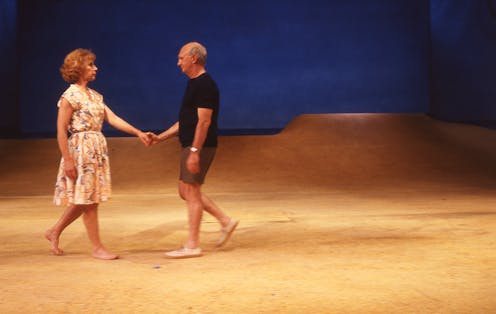
Away by Michael Gow has a prolific production lineage. Since its first staging by Griffin Theatre Company in 1986, the play has become a staple of professional, school and amateur seasons. It propels Gow into the microscopic family of Australian playwrights who have written an “Australian classic”, but it is also quite unlike any other play that shares that title.
The play is sometimes remembered as a small, domestic drama; its scale and ambition often forgotten. Gow sets his play inside a Shakespearean framework, complete with five acts and explicit references to A Midsummer Night’s Dream and King Lear. In addition, there are dance numbers, a comedic interlude with clown-like campers, and a dramatic storm featuring fairies.
Set against the turmoil of the Vietnam War, Away focuses on three sets of parents mourning their children while attempting to enjoy a summer holiday.
English immigrants Vic and Harry are desperately trying to cultivate hope for their teenage son Tom, whose leukaemia is in remission. Jim and Gwen are parents to Meg, hungry to strike out from her abrasive mother. Most devastating is Coral and Ray, who have lost a son to the war.
A summary of the play would make it seem a tragedy, but successful productions of Away are often cited for their tenderness and comedy. To read the script – as countless high school students have – the devastating grief at the heart of the play barely registers. Instead, Gow buries it in subtext, making it an actor’s delight.
But perhaps most interesting, 35 years on, is how remarkably different Gow’s writing was to his peers at the time.
A different kind of playwright
David Williamson premiered Don’s Party[1] in 1972, cementing Williamson’s trademark style. His biting, satirical realism served to skewer the nationalistic pride that had come in the generation before him in works such as Ray Lawler Summer of the Seventeenth Doll[2] (1955) . Williamson gave voice to a new version of middle-class Australia, manifesting in a restless populous that elected Gough Whitlam to power.
Read more: Don’s Party at 50: an achingly real portrayal of the hapless Australian middle-class voter[3]
Playwrights such as Louis Nowra[4] followed in Williamson’s wake. His plays, like Inside the Island (1980), poke fun at the great Australian patriarch most familiarly described as an “ocker”: the land-loving patriot who was often revealed as violent, drunk and incompetent in these satirical works.
In Away, however, the men are long-suffering fathers, often attempting (and failing) to tame or defend their forthright, anxious wives.
Gow treats all his characters with compassion. Unlike other Australian plays of the era, Away doesn’t have an ironic or satirical detachment. It instead sinks into the private and intimate lives of family holidays, while also asking big questions about the state of the nation.
Away’s Australia
This is a play about the hard-working middle-class: parents perpetually insecure in their relationship to the future generation.
Coral attempts to console herself over the loss of her son. She tells herself he paid the price to experience the luxuries of the country with the “highest standard of living on Earth”. It is of little comfort.
Tom’s parents desperately attempt, and fail, to keep the true bleakness of his illness away from him.
Gwen and Jim are permanently aspirational, seeking to protect their daughter Meg from the economic instability and hardship they experienced as young people. Gwen is so anxious about this desire she alienates her teenage daughter and almost everyone around her.
In the 1960s, when the play is set, 40% of Australia’s population was under the age of 21, and Gow reflects on the awful vulnerability of parenthood. Many Australian playwrights are obsessed with inter-generational angst. The most straightforward explanation for this is Australia’s cultural amnesia to its violent past[5].
Read more: Beyond Sorry: colonial oppression on Australian stages[6]
First Nations cave paintings receive a brief, banal mention in Away (“Amazing!” says one of the parents, enjoying them as a tourist), but the play was still written several years before Seven Stages of Grieving[7] (1995) by Wesley Enoch and Deborah Mailman, the first Indigenous Australian work to penetrate the mainstream theatre consciousness.
Most seductively, Gow offers a hopeful vision of Australia’s future generations. True to a Shakespearean comedy, the play ends with broken couples reuniting in domestic, wedded comfort. Despite unbearable grief, the families grow and heal.
Away today
It isn’t easy to pinpoint any particular reason behind Away’s enduring appeal. It is a well-written play, deserving of analysis and discussion, but there are likely more pragmatic reasons. The large ensemble casts make it suitable for diverse groups; its narrative threads are mostly contained to duologues, making it easy to rehearse; the script is punctuated by monologues which actors have used as staples of auditions into drama schools since its premiere.
It is difficult to find plays as tender as Gow’s in the grunge era of the 1990s and the globalised angst of the new millennium. Away represents a unique moment in Australian playwrighting and production.
Like most great Australian works, it speaks to a love of the land, a tremendous unspoken sense of loss and a yearning for belonging. Now, La Boite Theatre Company in Brisbane has promised a “sun-kissed” revival for 2021[8]. Away will remain with audiences for some time yet.
References
- ^ Don’s Party (theconversation.com)
- ^ Summer of the Seventeenth Doll (www.austlit.edu.au)
- ^ Don’s Party at 50: an achingly real portrayal of the hapless Australian middle-class voter (theconversation.com)
- ^ Louis Nowra (apt.org.au)
- ^ cultural amnesia to its violent past (theconversation.com)
- ^ Beyond Sorry: colonial oppression on Australian stages (theconversation.com)
- ^ Seven Stages of Grieving (www.austlit.edu.au)
- ^ has promised a “sun-kissed” revival for 2021 (laboite.com.au)