Teledyne e2v Develops Space Computing Reference Design featuring Microchip’s Radiation-Tolerant Gigabit Ethernet PHYs
New QLS1046-Space reference design provides high-speed data connectivity in space applications
GRENOBLE, FRANCE - Media OutReach - 12 October 2023 - Teledyne e2v is developing, in collaboration with Microchip Technology, a ground-breaking space computing reference design to enable high-speed data routing in Space applications.This innovative reference design will be presented at EDHPC 2023 (European Data Handling & Data Processing Conference, October 2-6, 2023, Juan-Les-Pins, France).
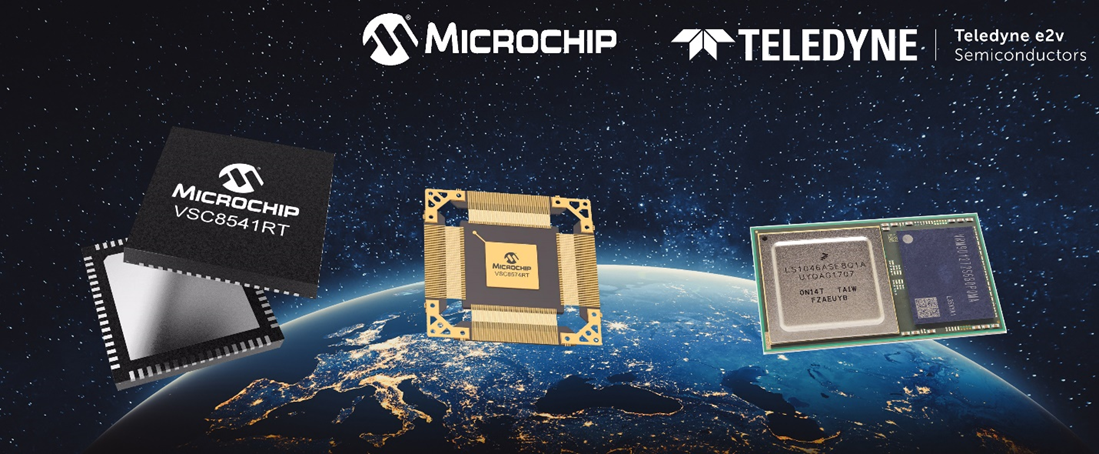
Featuring Teledyne e2v's Radiation Tolerant Qormino® QLS1046-Space processing platform, alongside data communication technology from Microchip, the space computing reference design is fully radiation-tolerant (RT) . It delivers a combination of robust, high-performance processing, plus enhanced subsystem connectivity capabilities. Thanks to the 30,000 DMIPS computing capability offered by the quad Arm® Cortex®-A72 cores and 4 to 8 GB of high speed DDR4 of the QLS1046-Space, and its multiple high-speed interfaces, the architecture can process and route large incoming data rates from various sources, including telecommunication RF front ends, high-resolution image sensors, radars, and other processing devices in the spacecraft.
The high-speed connectivity is ensured with the Gigabit Ethernet interfaces, supported by Microchip's RT Ethernet PHYs. The space computing reference design uses the VSC8541RT PHY to offer two RGMII links, as well as the new VSC8574RT to offer two SGMII interfaces, leading to a total of four Gigabit Ethernet connections. This number could even be ported up to seven Ethernet interfaces by exploiting all high-speed interfaces available on the QLS1046-Space, and up to 18 with the future LX2160-Space.
This enables high-speed transfers between the QSL1046-Space and the other devices placed on different accompanying boards within the satellite or spacecraft. Target use cases for this space computing reference design include, among others, Earth observation, SATCOM applications, defense in space, and space debris monitoring.
"In the vast majority of cases, modern Space hardware will have a decentralized architecture. Normally communication between the constituent subsystems relies on 10-100Mbit data transfer rates. Greater levels of functional sophistication are now being incorporated for purposes like advanced telecommunication schemes, real-time image processing, AI-driven analysis, and navigation. This means that augmented performance is being mandated," explains Thomas Porchez, Application Engineer at Teledyne e2v. "By working with Microchip, we've been able to significantly boost the interfacing capabilities for designs using the QLS1046-Space, leading to accelerated speeds plus extended propagation range. Consequently, they are completely aligned with what Space customers are now demanding for edge computing applications."
"Integrating Microchip's family of radiation-tolerant Gigabit Ethernet PHYs into Teledyne e2v's space computing reference design will provide space customers with high reliability and high-speed connectivity in a variety of space applications," said Nicolas Ganry, senior marketing and applications manager of Microchip's aerospace and defense business unit. "For over 60 years, Microchip remains committed to the enablement of space missions."
Staff from both Teledyne e2v and Microchip will present papers relating to their involvement in edge-located processing and inter-board communication for Space deployments at the EDHPC conference.
Hashtag: #Teledynee2v
The issuer is solely responsible for the content of this announcement.
About Teledyne e2v
Teledyne e2v's innovations lead developments in healthcare, life sciences, Space, transportation, defense and security and industrial markets. Teledyne e2v's unique approach involves listening to the market and application challenges of customers and partnering with them to provide innovative standard, semi-custom or fully custom solutions, bringing increased value to their systems.