Mainland Chinese businesses increasingly embrace digitalisation
BEIJING, CHINA - Media OutReach - 8 September 2023 - Accounting and finance professionals in Mainland China are embracing new technology at a rapid rate, according to one of the world's largest accounting bodies.
A new report from CPA Australia reveals that a growing number of businesses have adopted digital transformation strategies.
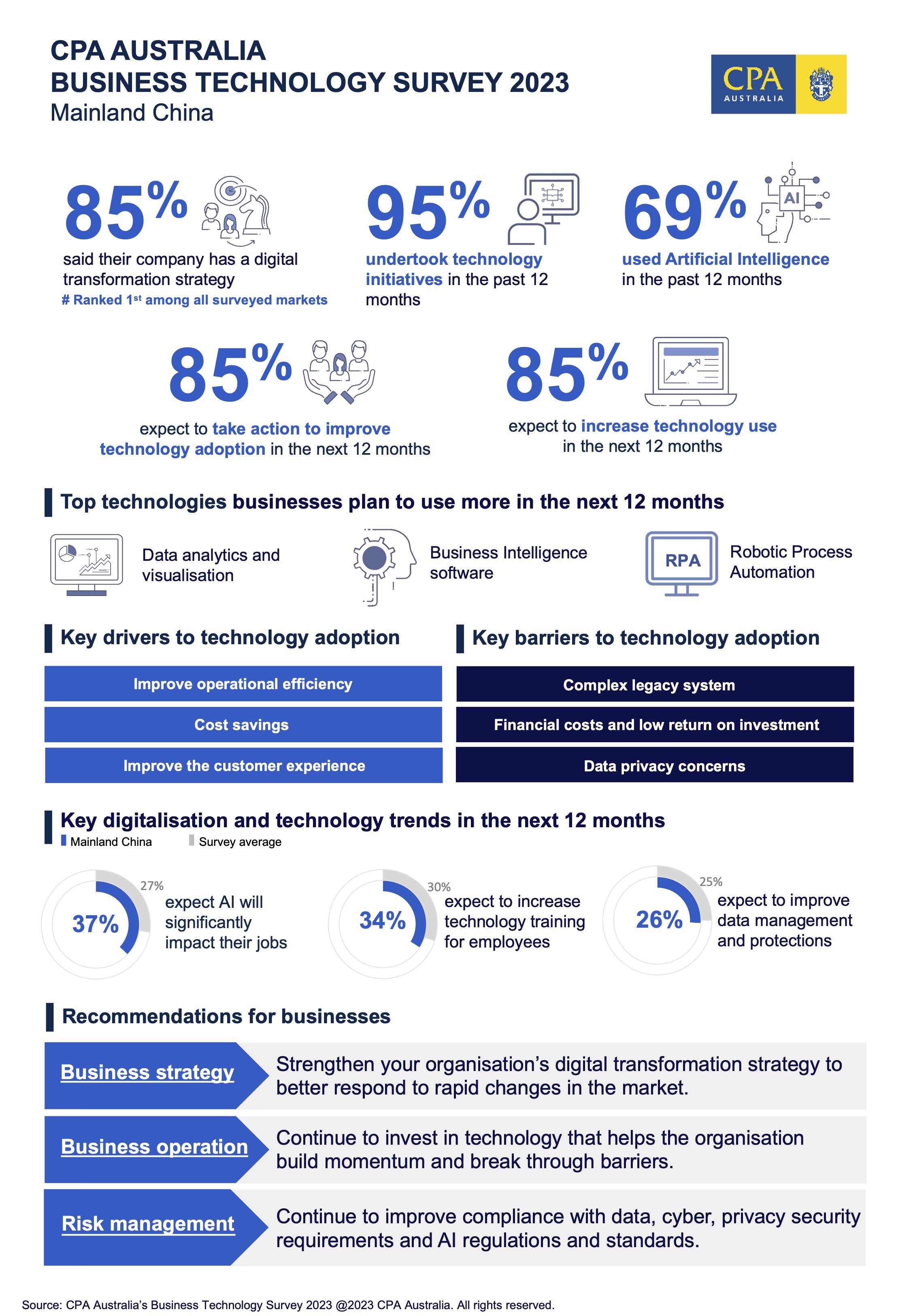
CPA Australia's 2023 Business Technology Survey was conducted from May to July 2023 across the Asia-Pacific. We received responses from 697 finance and accounting professionals. About one-third of respondents hold C-suite or other senior level positions.
We found that a remarkable 85 per cent of businesses in Mainland China have a digital transformation policy, up five percentage points from the same time last year. This is the highest percentage of businesses from across the Asia-Pacific region featured in the report.
This trend looks set to continue, with 85 per cent of Mainland Chinese respondents agreeing that their employer is planning to increase their use of technology in the next 12 months.
"The digital economy has become a key driver of economic growth. Despite a myriad of uncertainties and challenges in Mainland China's economic recovery, we are glad to see that businesses have continued to invest in digitalisation and innovation," said Tony Chan FCPA (Aust.), Deputy President of CPA Australia's South China Committee.
"It's positive to see the increasing awareness and willingness of Mainland Chinese SMEs to digitalise. Seventy-six per cent of respondents from SMEs stated that their company has a digital transformation strategy. This is eight percentage points higher than last year's survey result."
"We welcome recent government support for Mainland China's digital economy. This may boost business confidence in investing in digitalisation and innovation. Such actions could improve their operational efficiency, empower the digital transformation of industries and inject vitality into economic growth."
Artificial intelligence (AI) is the technology that Mainland Chinese businesses increased their use of the most in the past 12 months, according to the report. Sixty-nine per cent of respondents reported that their company used AI in the past 12 months. This is nine percentage points higher than in 2022, and well ahead of the survey average (55 per cent).
"A series of policy support initiatives and the rapid development of generative AI have significantly boosted AI adoption in Mainland China," Chan commented. "To reap the rewards from future innovation and enhance competitiveness, we recommend businesses continue upskilling the technology capabilities of their employees."
When survey respondents were asked which technologies they expect their organisation to use more in the next 12 months, data analytics and visualisation software (37 per cent) were the most popular options. In addition, more than one-third of respondents expect their businesses to increase technology training for employees.
According to Collin Jin FCPA (Aust.), a member of CPA Australia's East and Central China Committee, "Investment in areas such as data analytics and talent upskilling can help businesses gain valuable insights and assist in targeted investment for the next stage of digital transformation. Data capture and analysis could also accelerate the low carbon and green transition of businesses and ensure their long-term sustainable development."
As Mainland Chinese businesses head into a more demanding and intricate stage of digitalisation, challenges have also emerged. The survey identified that complex legacy systems (29 per cent), financial costs and low return on investment (26 per cent) and data privacy concerns (25 per cent) are the key barriers to technology adoption in Mainland China.
"We understand that replacing complex systems can be difficult and at times expensive, however obsolete systems can impact business performance and profitability. To address this challenge, we recommend companies continue allocating appropriate resources to review their IT infrastructure and systems to ensure they meet both internal needs and external requirements," Jin commented.
"Considering the pace, complexity and costs of technology development, it's imperative for businesses to pay attention to the return of investment of technology and digital transformation projects and identifying technology tools and software suitable for the organisation."
"We also recommend businesses place greater emphasis on digital solutions that elevate their efficiency, bolster resilience, and heighten competitiveness. Examples include digital tools that improve supply chain management and customer service."
Read CPA Australia's Business Technology Report 2023
Hashtag: #CPAAustralia #Business #Economics #DigitalEconomy #Digitalisation #AI #MainlandChina #Data #Innovation
The issuer is solely responsible for the content of this announcement.
About CPA Australia
CPA Australia is one of the largest professional accounting bodies in the world, with more than 172,000 members in over 100 countries and regions, including more than 23,200 members in Greater China. We have offices in Beijing, Shanghai and Guangzhou. CPA Australia provides thought leadership on local, national, and international issues affecting the accounting profession and public interest. We engage with governments, regulators and industries to advocate policies that stimulate sustainable economic growth and have positive business and public outcomes. Find out more at cpaaustralia.com.au