How to Help Buyers Understand a Home Before the Showing
- Written by: Times Media
A buyer should not have to visit a property just to figure out what the rooms are supposed to be.
Yet that happens surprisingly often.
Photos may show beautiful finishes and natural light, but they do not always explain scale, layout, or how a room might actually be used.
This becomes even more noticeable with vacant homes. Without furniture, a bedroom can look smaller than it really is. An open living area may feel undefined. A spare room might look like little more than four empty walls.
The good news is that a listing does not need dozens of extra images. It just needs the right visual information.
Show buyers what a room could be
Empty rooms leave a lot to the imagination.
Some buyers are good at looking at a vacant living room and mentally placing a sofa, coffee table, and television.
Others are not.
That is where staging helps.
Physical staging works well, but it can require furniture rental, transportation, setup, and additional expense. For properties that are already vacant, digital alternatives can be much simpler.
Using free virtual staging allows sellers or agents to explore how a room might look furnished without physically changing the property.
The key is to keep the result realistic.
A small bedroom should still look like a small bedroom. A modest condo does not need to be turned into a luxury penthouse.
Good staging should clarify the space, not exaggerate it.
Use furniture to show scale
Furniture is useful because buyers already understand its approximate size.
A bed gives context to a bedroom.
A dining table shows whether six people could comfortably sit in a space.
A sofa helps explain the proportions of a living room.
This is one reason empty rooms can be difficult to judge from photographs alone.
When staging digitally, use furniture that makes sense for the room rather than whatever looks most impressive.
If a sofa barely fits, buyers will notice when they visit.
If the furniture is unrealistically small, the listing may create the wrong impression.
Believable scale builds trust.
Do not make buyers guess how the rooms connect
Even strong photography has one limitation: it usually shows one room at a time.
A buyer may see a great kitchen followed by a great living room but still have no idea how the two connect.
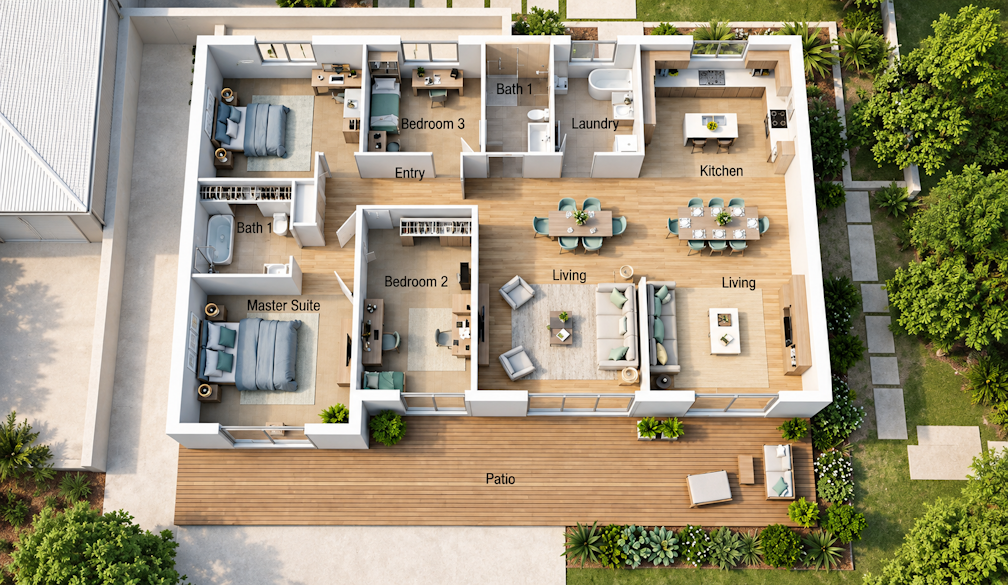
This is where a floor plan adds value.
It helps answer questions that individual photos cannot:
- Is the kitchen open to the living room?
- How far is the primary bedroom from the other bedrooms?
- Where does the hallway lead?
- How does the dining area connect to the rest of the home?
For buyers who find traditional plans difficult to read, converting a floor plan to 3D model can provide a more intuitive way to understand the property.
Instead of interpreting lines and symbols, they get a clearer sense of the home's overall structure.
Show enough, but not everything
More visuals do not automatically make a better listing.
Too many similar images can make buyers lose interest.
A stronger approach is to give each visual a purpose.
For example:
An original photo shows the actual condition of the room.
A staged image shows one realistic use.
A floor plan explains the layout.
A 3D view helps communicate the relationship between spaces.
Each one answers a different question.
There is little value in adding five staged versions of the same living room if one clear example already explains the space.
Keep the original room visible
Digital visualization works best when buyers can easily distinguish between what exists and what has been added.
If a room is virtually staged, keep the original photograph in the listing too.
This gives buyers both pieces of information:
“This is what the room currently looks like.”
“This is one way it could be used.”
That approach feels more transparent and gives buyers more confidence in what they are seeing.
The same applies to renovation concepts. If a visualization shows a possible future layout, it should be clear that it is a concept rather than the property's current condition.
Think like someone seeing the home for the first time
When sellers have lived in a home for years, the layout feels obvious.
They know where the dining area is.
They know the spare room fits a desk.
They know that a certain corner gets beautiful afternoon light.
A buyer does not know any of that.
Look through the listing as if you had never seen the property before.
Would you understand what each room is for?
Could you judge the scale?
Would you know how the spaces connect?
If something feels unclear, that is probably where an additional visual would be most useful.
Final Thoughts
A good property listing should make a home easier to understand before the buyer ever walks through the door.
That does not mean making every room look perfect.
It means giving buyers enough context to understand scale, function, and layout.
Realistic staging can show how an empty room might work. Floor plans and 3D views can explain how the home fits together.
Used together, these visuals answer the questions that photography alone sometimes cannot.
And when buyers understand a property more quickly, they can spend less time guessing and more time deciding whether it is right for them.