Why Gaming Culture Shapes Who People Are
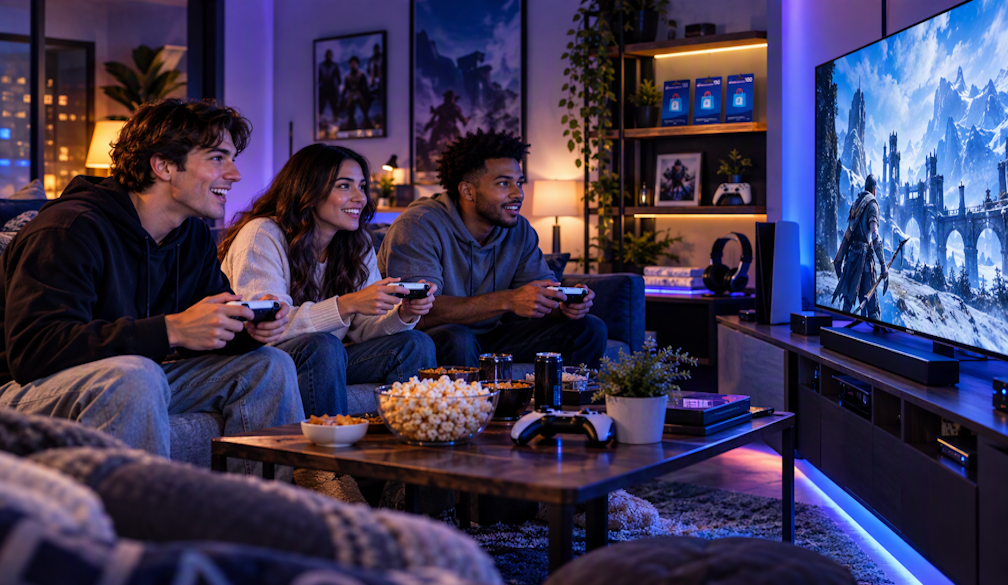
Gaming culture influences the way people signal interests and find common ground, but it does not write a fixed personality script. In Australia, it belongs to everyday cultural life: an ACCC survey of 3,075 people aged 14 and older found 69% had played games on at least one device in the previous six months. The ACCC also describes online gaming as entertainment and social connectivity, with smartphones or tablets the most commonly used devices. That reach helps explain why gaming references appear in friendships, creative pursuits and ordinary conversation.
PlayStation gift cards can be bought from official retailers or digital marketplaces that list gift card codes. For a player joining a shared conversation around a new release or digital content, a practical option is to Buy PlayStation gift card codes through Eneba. The marketplace lists game keys, gift cards and other digital products, and its product pages state platform and regional information. Verified merchants offer a clear purchasing context, and matching the listed region to the PlayStation account region supports appropriate access.
Identity and personality are not the same
Games provide settings where cooperation, competition, leadership, humour and creativity can be expressed. Those settings can let a player test a role, display a preference or contribute to a group, yet the evidence does not show that gaming alone creates fixed traits like confidence, empathy or sociability. Personality develops through many parts of life, including relationships and circumstances beyond play. Gaming can be meaningful self-expression without becoming a complete definition of a person.
The gamer label also reflects social context rather than participation alone. A Journal of Computer-Mediated Communication study found that friendship networks provide an important environment for performing gamer identity, and people who see more friends as gamers are more likely to include that category in their self-concept. Shared sessions and follow-up conversations provide recurring points of reference, helping group membership become visible. Many people who play do not use the label, as age, gender, friendship networks and cultural stereotypes can influence its appeal.
Social circles and creative expression
Social connection sits at the centre of many gaming experiences, though communities are not uniformly positive spaces. An eSafety Commissioner study of more than 2,000 Australians aged eight to 17 found that young people often played or communicated with family, friends and people they did not already know offline. Social connection was a common reason for online play, and the research also documented opportunities and risks. In a separate US Pew survey, 89% of teen players said they played with others in person or online, a figure that is not an Australian measure.
The same US survey reported that 72% of teen players cited spending time with others as a reason for playing, while 47% said they had made an online friend through a video game. Those figures illustrate shared play in that survey, rather than a universal account of gaming relationships. Beyond a session, players may express an existing identity, an idealised self or an imagined persona through an avatar. A qualitative study of 12 players from the UK and US found that customisation and game difficulty could influence the player-avatar relationship, without defining every player.
Creative activity can take gaming culture into building, streaming, cosplay, fan fiction and drawing, where interests can become visible in online profiles, hobbies and offline friendships. Gaming culture shapes identity through participation, connection and creative expression, not by dictating personality. Digital marketplaces like Eneba offer deals on games, gaming top-up, and more, fitting into the everyday choices behind shared play and personal expression.