When a Standard Flat Top Isn't Enough: Deck Wideners and Extendables Explained
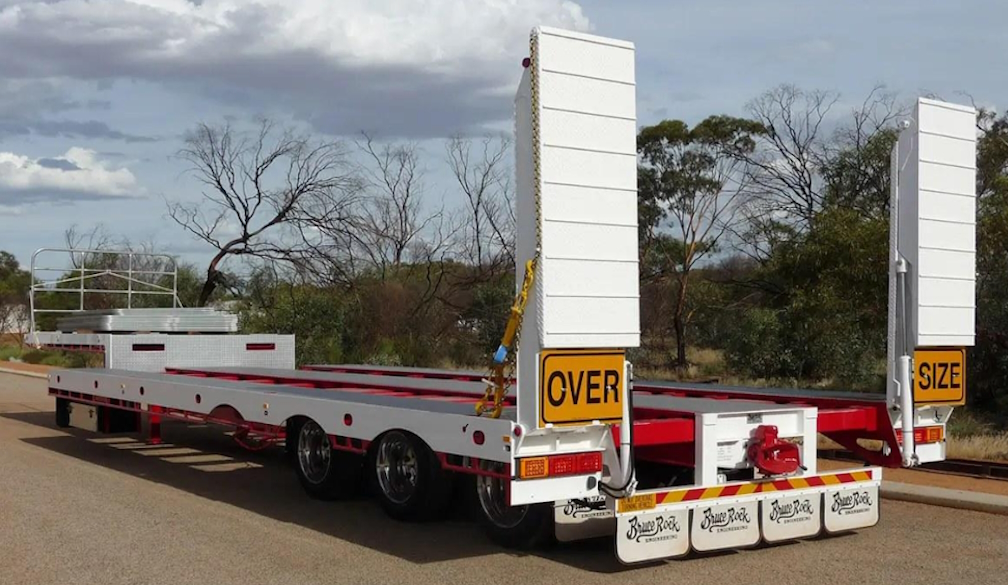
Ask a dozen operators what their flat top cannot do and the answers line up fairly quickly. It is not the weight. Flat tops handle weight. It is the shape of the freight, which is a different problem entirely.
A 3.2 metre tank. Twenty one metres of truss. A transformer sitting proud of the coaming on both sides, leaving you looking at the gap. Getting a permit for any of that is the straightforward part. Getting the load properly supported on a deck that was never built for it is not.
Where a Standard Flat Top Runs Out of Deck
Under general access a prime mover and semi stops at 2.5 metres wide, 4.3 high and 19 long. Flat top and drop deck trailers get built to live inside those numbers, which is precisely why they are the default across most fleets.
Go past them and you inherit two problems.
The first one everybody knows about already. Over 2.5 wide and the movement becomes Class 1 oversize, so permits, warning lights, signage and, once the width climbs far enough, pilots. Costly. Not complicated.
The second one is quieter. Wider than the deck means the edges of the load are sitting over nothing at all, and length behaves the same way. Rear overhang stops at the lesser of 5.5 metres or a quarter of the combination's total length, so pushing a long item back off the tail until it fits is not an option either.
Restraint needs deck underneath it. Lashings over fresh air do not restrain anything. They only look like they do.
What a Deck Widener Actually Does
It grows the deck. Hydraulic or mechanical sections slide outboard off the chassis and take the working width from standard out to somewhere near 3.5 metres, build depending. The load sits on bearers right across its footprint, lashings pull down onto steel, and the gap problem goes away.
Spec wise there is nothing unusual going on. Forty five foot tri-axle drop deck widener, airbag suspension, drum brake axles, grit finish over the deck and ramps. Units like that shift graders and crushing plant all year.
One thing to clear up, because it gets repeated often enough to stick. Widening the deck does not make the load legal. Permits follow the dimensions of the freight, not the trailer. What you are buying is support and restraint, and that is the half of oversize work that actually hurts when it goes wrong.
What an Extendable Deck Adds
Length. The chassis telescopes, so a deck closed up at 45 feet opens out for bridge beams, pipe, tower sections and roof trusses, with something sitting under the middle of the load rather than a long unsupported span.
Closed, it is just a trailer again, which means palletised freight on the way home instead of running empty. That tends to be the part that wins the business case.
The catch is thinking an extended trailer is the same trailer. It is not. Capacity drops as it opens out, and the load wants concentrating over the support points instead of spread down the length of it. Plenty of chassis have cracked teaching somebody that.
What the Trade-Offs Cost You
Tare, to start with. Slides, pins, hydraulics, the structure carrying all of it, and every kilo comes off payload. For high volume general freight the numbers never really get there.
Maintenance next. Slide mechanisms spend their lives in dust, grit and road spray, which means greasing and inspection on a schedule rather than on the day something starts binding. Pin engagement is a pre-start item. Everyone agrees with that in principle. Not many fleets have it on the sheet.
The sensible objection is hire. Two or three oversize movements a year and hire is clearly right. It stops being right when the gear you need is out with everyone else during a shutdown, and when the jobs you are turning away are the ones carrying the margin.
How to Choose Between Them
Which way does your freight break. Wide points at a widener, long points at an extendable, and a fair number of operators end up wanting a bit of both in the one build. That is a conversation rather than a tick box: deck configuration, suspension, axle layout, ramps, self-tracking axles.
Then frequency. Three or four oversize jobs a year, hire them. Three or four a month, own one.
How to Spec It Before You Need It
Standard flat tops still carry most of what needs carrying and that is not about to change. Wideners and extendables answer a narrower question: what happens when the load runs off the edge of the deck. Work out which direction yours runs before anyone starts quoting, because a trailer ordered for the wrong problem is a trailer you order twice.